

Primarily located in Heidelberg and Penn Townships in York County, Pennsylvania, Oil Creek spans a 16.8-square-mile watershed and is a tributary of the Codorus Creek, which ultimately flows into the Susquehanna River and Chesapeake Bay. Decades of timbering, agriculture and milling operations have led to the accumulation of legacy sediment, disrupting many of the essential functions of a stable, fully-functioning riparian area.
Our Environmental team was brought in by the Rail Trail Authority to work with C.S. Davidson and Land Studies to restore more than 5,700 linear feet of Oil Creek. The project’s goal included improving local and regional water quality, protecting the future rail corridor, and providing ecological and aesthetic benefits to landowners and the community. Over the course of construction, our team worked to remove legacy sediment and restore the floodplain to conditions that closely mirrored pre-settlement conditions.
Clearing the Way
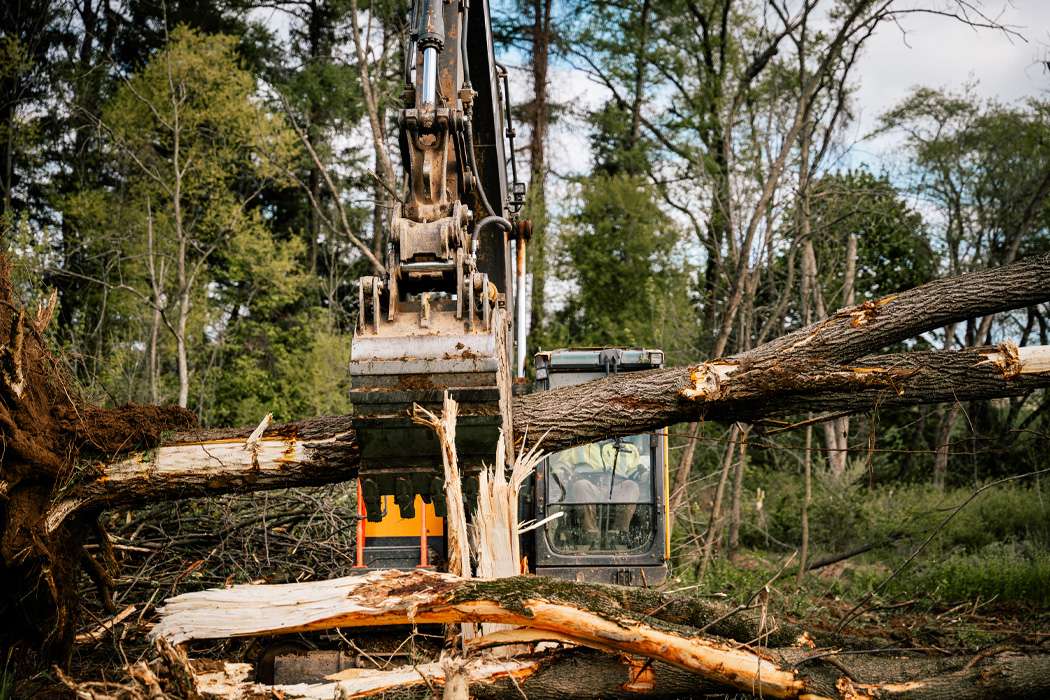
In mid-April, we quickly got to work on this project. Partnering with our Clearing crew, the first phase involved clearing approximately 12 acres of trees. While trees are vital to many ecosystems, strategic clearing was necessary for this restoration project to achieve long-term ecological benefits. Our team had to complete this work in under a month due to restrictions protecting the endangered Northern Long-Eared Bats inhabiting the area. After the trees were cleared, the Clearing team cut them into sections — including logs, root wads and treetops — which were strategically scattered across the site to reshape the floodplain and restore its stability and function.
With tree clearing complete, our field crew installed a 12-inch bypass pump to temporarily divert the streamflow, enabling the construction of a diversion ditch. This ditch directed water throughout the duration of the project, allowing us to excavate in dry conditions without the risk of storm events flooding the area and delaying our schedule.


Channeling Success
With the site preparations complete, we began the restoration phase. We excavated 45,000 cubic yards of dirt and legacy sediment to expose the historic gravel layer. Next, we constructed a new channel through the floodplain and redistributed the salvageable topsoil.
Within the channel we installed a series of riffle pools with a rock underlayment to dissipate energy. This controlled water flow, reduced erosion and promoted sediment deposition to restore natural stream functions. We also created deep depressions within the channel and added root wads and woody debris to enhance habitat complexity, slow water velocity and provide refuge for aquatic species.
Finally, we planted approximately 43 native species—including trees, shrubs and wetland plugs—in designated areas ideal for their growth, ensuring the restored ecosystem’s long-term sustainability.


Cultivating Resilient Ecosystems
Today, Oil Creek is thriving as a fully-functioning riparian habitat, providing numerous benefits to the local ecosystem. The newly restored floodplain has reestablished natural water flow, reducing erosion and sediment build-up downstream. By stabilizing the banks and enhancing water quality, the creek is playing a vital role in maintaining the health of the Codorus Creek watershed, which ultimately feeds into the Chesapeake Bay.
This restoration effort is a testament to our mission: to collaboratively cultivate resilient ecosystems, mitigate flood risks and promote biodiversity throughout the Mid-Atlantic region. By working closely with local partners and employing sustainable restoration techniques, we are fostering lasting environmental and community benefits. As we continue to restore critical habitats like Oil Creek, we remain committed to promoting ecological stewardship and ensuring a healthy environment for generations to come.


